Causes and Usage Tips
Many users notice the same problem every winter:
power banks drain faster, charge slowly, or even stop working in cold weather.
The truth is, this is not a quality issue.
All lithium-battery-powered devices perform worse at low temperatures, including power banks, smartphones, and laptops.
Understanding why this happens—and how to use power banks correctly in winter—can help extend battery life and avoid unnecessary damage.
Why Does a Power Bank Lose Power Faster in Cold Weather?
Lithium Batteries Are Sensitive to Low Temperatures
Power banks use lithium-ion or lithium-polymer batteries, which are highly temperature-dependent.
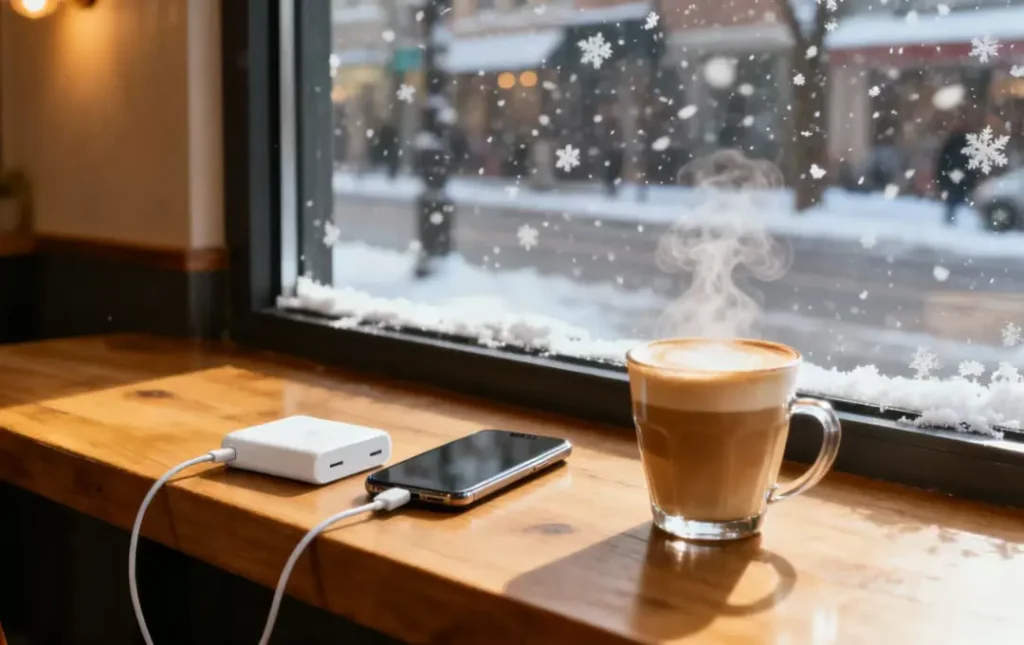
In cold environments, battery performance drops due to the following reasons:
1. Slower Lithium-Ion Movement
At low temperatures, lithium ions move more slowly inside the battery, reducing discharge efficiency. This results in:
Faster visible power loss
Slower phone charging
Unstable output performance
2. Increased Internal Resistance
Cold temperatures increase internal resistance, meaning part of the stored energy cannot be effectively released.
For example, a displayed 60% battery level may deliver only 30–40% usable capacity.
3. Voltage Drop and Protection Shutdown
Low temperatures can cause sudden voltage drops below the safety threshold.
To protect the battery, the power bank may:
Stop output suddenly
Automatically shut down
Refuse to charge connected devices
At What Temperature Does Power Bank Performance Decline?
Although performance varies by brand and battery design, general rules apply:
Below 0°C (32°F): Noticeable performance degradation
Below -10°C (14°F): High risk of output failure
Optimal operating range: 10°C–35°C (50°F–95°F)
This is why winter travel, skiing, camping, and outdoor work often make power banks feel “unreliable.”
5 Important Tips for Using Power Banks in Winter
1. Avoid Long Exposure to Cold Environments
Keep the power bank in a jacket pocket close to your body, not in a backpack, car, or outdoor compartment.
2. Let the Power Bank Warm Up Before Charging
After coming indoors from cold weather, wait 5–10 minutes before charging or using the power bank to allow it to return to room temperature.
3. Avoid Fast Charging in Freezing Conditions
Low temperature combined with high current accelerates battery aging.
Use low-power charging first, then switch to fast charging once the device warms up.
4. Never Leave Power Banks Outside Overnight
During winter camping, keep the power bank inside your sleeping bag or tent to prevent extreme discharge or protection shutdown.
5. Choose Power Banks with Low-Temperature Protection
Advanced power banks include temperature detection chips that:
Adjust output power automatically
Limit high-current charging
Improve safety and stability in cold conditions
Fast Power Loss in Winter Does NOT Mean Battery Aging
Many users assume that rapid winter power loss means the battery is damaged. In most cases, this is incorrect.
Battery performance usually recovers once the temperature returns to normal.
To determine real battery aging, check performance at room temperature:
Does it still drain unusually fast?
Is self-discharge high after one day?
Is output unstable?
Is charging speed permanently reduced?
If issues only occur in winter, the battery itself is likely still healthy.
Final Thoughts
Cold weather affects lithium batteries by design—it is a physical limitation, not a manufacturing defect.
By understanding the science behind battery behavior and using power banks correctly in winter, users can maximize performance, extend battery lifespan, and avoid unnecessary replacements.
For OEM and ODM power bank manufacturers, low-temperature performance optimization and protection features are becoming increasingly important for global markets.